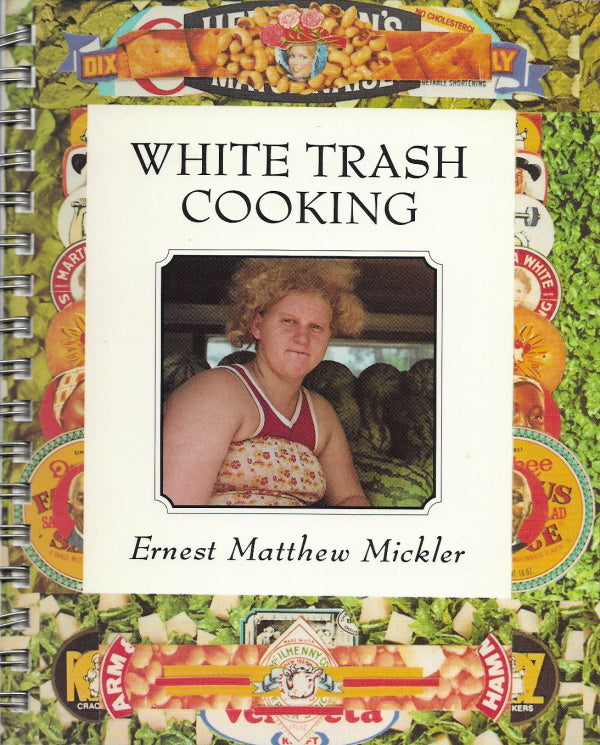
OP: White Trash Cooking
Shipping calculated at checkout
The Jargon Society, North Carolina, 1986. Spiral bound. Good Plus. Second printing.
In the spring of 1986 a revolutionary cookbook was published—one, paradoxically, rooted in tradition. Here, in an ethnographic survey, Floridian Ernest Matthew Mickler (1940–1988), documents the food of ordinary people—mostly poor, not the beneficiaries of fancy educations, and definitely in pursuit of food that is hearty rather than wholesome.
Mickler qualifies the demographic in his introduction:
But the first thing you’ve got to understand is that there’s white trash and there’s White Trash. Manners and pride separate the two…where I come from in North Florida you never failed to say ‘yes ma’m’ and ‘no sir,’ never sat on a made-up bed (or put your hat on it), never opened someone else’s icebox, never left food on your plate, never left the table without permission, and never forgot to say ‘thank you’ for the teeniest favor. That’s the way the ones before us were raised and that’s the way they raised us in the South.
The dialect and syntax immediately transport you to kitchens where you would readily find a practiced recipe for Uncle Willie’s swamp cabbage stew, spaghetti casserole, cold collard sandwiches, mock cooter soup, chicken feet and rice, Resurrection cake served with whiskey sauce, and lots and lots of gravy.
With amusing comments about their recipes by the contributors and thirty-two pages of judgment-free photographs, this is a classic work, continuously in print for nearly forty years.
First printed by The Jargon Society, a North Carolina-based publisher of poetry, photography, and criticism, the book has a fundamental honesty that struck a spark. It rapidly became a success, much too large for the small publisher to maintain. Eventually the Berkeley-based Ten Speed Press took it on.
Ours, a second printing of the original Jargon Press edition, is what we can only call a Good Plus copy of the 140-page spiral-bound book, due to liquid damage which affects the upper fore corner. Otherwise, clean and sturdy. To our knowledge, only 5,000 copies were printed of the Jargon edition. It’s not often seen and a nice addition to an American collection.